You can’t judge someone through misconception--> isolation:
This theme is illustrated throughout the novel and is also prevalent in American culture. The famous adage “don’t judge a book by its cover” perfectly conveys the idea that one cannot judge something or someone based upon appearance, race, religion, etc. Many times when one embarks on a trip to the bookstore to look for a new novel or some other piece of literature, he or she will many times be attracted towards the book with the creative title or cover. Unfortunately, people walk past great works of writing because they simply did not devote the time to look at what is underneath the cover. Simply looking at a book with a dull and boring title may make individuals want to walk away and go search for something more “exciting.” The idea of judging books by their cover can be generalized to social settings; in Terrorist, this is seen with Ahmad’s misconception about the west and anything not affiliated with Islam. For example, he considers all non-Muslims “godless” and that “they lack true faith; they are not on the Straight Path; they are unclean.” Similar to judging a book by its cover, he is judging anything or anyone who does not practice Islam as a “devil” and that all Americans are “obsessed with sex and luxury goods, because they have no God.” In other words, just because they don’t share the same views as he does, they are all unclean and sinful.
On the other hand, the misconceptions go both ways. After 9/11, the image of Muslims has drastically changed- in a negative way. Due to a lack of knowledge and respect, many Americans think of “terrorist” when they hear about a Muslim. Personally, I have been affected by 9/11 severely. Despite the fact that I am from Iran, a country that was not involved in the terrorist acts of 9/11, people still choose to refer to me as an “Arab” and believe Iran is a country filled with terrorists. Unfortunately, many classmates of Ahmad also treat him this way- even worse. In this situation, both Ahmad and his classmates are judging the other side. It doesn't matter whether we are judging a book or a complete different religion, culture or race- it is all the same. Choosing something over the other, or judging someone based on stereotypes will cause isolation- either it's a book, person, etc. (This is what inspired the background of my blog. The picture is of an isolated tree, similiar to Ahmad in America/the West). This was the biggest theme relevant in my novel.
Friday, December 11, 2009
Themes
Thursday, December 10, 2009
Finals Thoughts...
From reading some of Updike’s earlier novels, including Rabbit, Run and Witches of Eastwick, I have come to the conclusion that Terrorist is definitely not his best work. It is clear that he loves to use powerful description, and a lot of it, and can go on and on about describing the smallest thing. However, he tends to exhaust his details and they become extremely…boring. This is seen in chapter three, where he describes Mr. Levy’s wife finally answering a telephone in EIGHT pages. Yes, eight! All I’m saying is that he should just cut down on the details, a tad bit. It changes the novel’s speed- not only does it make the novel tremendously slower, but it takes way too much concentration to get through a simple description and it hardly has any action.
As I said above, hardly any action takes place in the 300+ page novel. When I picked up the novel, I imagined it to contain thrilling action that would make it difficult for me to put it down. But no, I was wrong. Hardly anything happens. I can explain the entire novel to you in just a couple of sentences: Ahmad’s Imam from the church persuades him to becoming a truck driver. His counselor, Mr. Levy, disagrees and wants him to go to college. He is worried about Ahmad’s decisions and future. Mr. Levy has a disgusting affair with Ahmad’s mother for quite some time. Ahmad’s boss gets him to be apart of a terrorist plot, to blow up a tunnel in New Jersey. He decides last minute to not blow the tunnel up. The end. That is pretty much all that occurs for over 300 pages.
I also had a problem with the characters. I can’t picture any of them in my head, they are just too unrealistic. As I said in the character study, Ahmad never comes off as a real teenager living in the states. Updike gives us no explanation as to why he suddenly decided to become a radical Muslim. He never even knew his Muslim father, so what on Earth could possibly want him to be such a hardcore Muslim? The two Black characters who go to high school with Ahmad, Joryleen and her boyfriend Tylenol, were so unrealistic that I found it humorous. Updike explains that Tylenol’s mother gave him that name because she “saw the name in a television commercial for painkiller and liked the sound of it.” And it doesn’t end there- they end up become a prostitute and pimp after they graduate high school. Hmm.
Not only that, but the affair between Jack Levy and Teresa (Ahmad’s mother) was very random, abrupt and did not come off as something believable. The descrpitions Updike gives Jack are so unpleasant and unattractive. He is about twenty-three years older than Teresa, and his beer-belly makes him not such an attractive person. Updike gives the reader hardly any explanation as to what led the affair, or anything to make the fact that a beautiful, young single mom fell into the arms of a much older man credible.
The novel’s ending gave me the impression that Updike wanted to end his writing as soon as possible. Not only did it seemed that he wrote it in a rush, and ended it abruptly, but it was also corny and stale. Ahmad, the boy who within 300 pages came off to be a complete anti-West and anything non-Islamic, who believed the Qur’an supported his terrorist thoughts, suddenly backed out of the bombing because he randomly chose to be a morally good human being. Then he and Mr. Levy drove back home, happily ever after. You have to admit, that does deserve a few laughs.
By all means, read this book if you enjoy long, exhausted details and corny plots that are unrealistic. I don’t want to end this blog on a bad note and completely bashing John Updike. Don’t get me wrong- he is not a terrible writer. He is just a writer with a terrible book.
I’d recommend Witches of Eastwick that actually was written to intentionally make you laugh.
Wednesday, December 9, 2009
Live and Let Live
As the novel is ending, Mr. Levy says something that really made me think. At this point, he is having a conversation with Teresa about Ahmad. Jack says “Kids today have more to worry about that we did. At least than I did…. It’s not just AIDS and the rest; there is a certain hunger for, I don’t know, the absolute, when everything is so relative, and all the economic forces are pushing instant gratification and credit card debt at them. It’s not just the Christian right—Ashcroft and his morning revival meeting down in D.C. You see it in Ahmad. And the Black Muslims. People want to go back to simple—black and white, right and wrong, when things aren’t simple…. All I am saying is that kids like Ahmad need to have something they don’t get from society any more. Society doesn’t let them be innocent any more. The crazy Arabs are right—hedonism, nihilism, that’s all we offer. Listen the lyrics of these rock and rap stars…” (p. 205). Kudos for Mr. Levy for his observation! He is so right, and has a point. We are constantly getting pushed more and more by our desires for certainty and purity. Some are getting pushed more than others, and this is seen through Ahmad: a devoutly religious Muslim pushed to extreme behavior involving terrorist activities. It pushes us away from the things we need in life, such as trust, and more towards an “us vs. them” thinking mentality. It pushes us out of civic asset, for example, and towards a new world of privacy: living behind private gated communities, attending private schools, and most importantly, private lives. What good does this give us? What are we getting out of it? Living this way breaks down the structure of the familiar community life we have all been used to, which actually requires us to know and love our neighbors.
This quote is continued for quite a while, and as I was reading it I felt that Updike is revealing his opinions and views through Mr. Levy. Updike knows exactly what he is talking about; perhaps he has had some personal experiences that inspired his writing of this certain passage. We are all living a life constantly in search of answers to questions we are not sure about. Ahmad goes through this exact quest, but his drives him mad because he finds a little problem with all of his surroundings, whether it is Americans or just non-Muslims. Kids are making more decisions than past generations have, “because adults can’t tell them what to do.”
Consider this continued conversation between Mr. Levy and Teresa, where he is letting out everything that is on his mind. He says, “Even at a dump like Central High, where the demographics are stacked against the whole school population, you see it- this wish to do right, to be good, to sign up for something- the Army, the marching band… The kids keep showing up, hoping for some guidance. In the halls, their faces break your heart, they’re so hopeful, wanting to be good, to amount to something. They expect something of themselves. This is America, we all expect something, even the sociopaths have some sort of a good opinion of themselves. They want to please society, though they say they don’t. They want to be worthy, if we could just tell them what worth really is” (pg. 206). At first, I did not clearly understand what Updike is trying to say through Mr. Levy’s quote, but all of a sudden it all came to me. We are forcing ourselves to live a life of “looking good” in the eyes of others, and to feel worthy. But what exactly does that mean? It seems that Mr. Levy is at a turning point in his life- a breakdown. He has lost hope. Or maybe he never even had it. He has failed in life, and has lost hope for every one, which is odd to me as to why he would choose to be a guidance counselor, since you know, they are supposed to be hopeful and guide their students to live successful lives. But I guess that’s beside the point. This is everything that I have always thought, but he words it perfectly. We all live with a high and unrealistic expectation for ourselves, as if we are being graded for how what we end up doing with our lives. We want to “please society,” but as Mr. Levy says, we don’t admit it. I can’t say this is true for every person in the world, but it certainly does relate to many. I wouldn’t be so hopeless about it though. I mean, not all of us live unsuccessful and unhappy lives. Maybe some of us know what it means to be worthy. Maybe we do actually “wish to do right, to be good, to sign up for something” and have a blueprint for our life and what we want to achieve. Maybe if we can get rid of all the unnecessary junk and that annoying voice in our head that is constantly telling us what we can do, we can get somewhere in life, and become worthy. Maybe then Mr. Levy can reconsider what he said. Just maybe.
Rhetoric Study
“Ahmad has felt the man approach, and then the presumptuous, poisonous touch on the shoulder. Now he is aware of, too close to his head, the man’s belly, its warmth carrying out with it a smell, several smells- a compounded extract of sweat and alcohol, Jewishness and Godlessness, an unclean scent stirred up by the consultation with Ahmad’s mother, the embarrassing mother he tries to hide, to keep to himself. The two adult voices had intertwined flirtatiously, disgustingly, two aged infidel animals warming to each other in the other room. Mr. Levy, having bathed in her babble, her insatiable desire to press upon the world her sentimental vision of herself, now thinks himself entitled to play with her son a paternal, friendly role. Pity and presumption prompt this unseemly, odorous closeness. Yet the Qur’an urges courtesy upon the faithful; this Jew, though self-invited, is a guest in Ahmad’s tent” (p. 94).
This passage depicts Updike’s style perfectly. I pulled this passage right out from the middle of the novel, where Mr. Levy comes to Ahmad’s house to speak to his mother about his concerns with Ahmad and his future. Here, Updike takes the reader inside Ahmad’s head, though not written in first person, he does a superb job doing so. He begins this passage with a great amount of suspense, which led to a lot of anticipation. Well, it did for me at least. As he mentioned in the last sentence, Mr. Levy was uninvited and came upon his wish. Knowing Ahmad and his dislike towards Mr. Levy, I kept wondering what he will do when he sees him. What will happen?
I think Updike’s greatest writing skill is his ability to describe things so accurately and expressively in detail. You know you are reading an Updike novel when you find yourself reading a description of a person with insomnia for fourteen pages. He has an uncanny ability to give us the exact feel for what a decaying inner city neighborhood is like, for example. Not only do his details provide us with a fairly accurate image in our head, but it also takes us inside the characters, most importantly Ahmad. Not only do I know what he looks like, and acts like, I know what goes on through his head. And that is because of Updike’s style.
Back to the passage above, Updike anticipates the reader with such precise and exact words to describe the tension and emotions going on in the room. I love the first sentence of this quote, and the words he chooses. He does not just decribe Mr. Levy’s touch as a plain old normal touch, but a “poisonous” and “presumptuous” touch. Without reading the novel, you are able to discover right away from his details how Ahmad thinks of Mr. Levy. But the details do not end there. Mr. Levy is not characterized as a man with just a “normal” smell. Instead, Ahmad automatically distinguishes the smell as one of “alcohol,” leaving him to be a “Godless” [ness] Jew. The passage goes on with specific details depicting what is going on, words such as “unclean,” “flirtatiously,” “disgustingly,” and even goes so low as to describing his mother and Mr. Levy’s conversation as “two aged infidel animals warming to each other in the other room.”
Just pulling out one small passage from the 300+ page novel showed how much detail Updike uses to describe Ahmad’s hatred towards the West, and anything or anyone that is not related to Islam. But details are not the only strategies he uses. Lengthy sentences, short dialogue, use of curse words and similes are his skills used to criticizing Americans. At the end of the novel when Ahmad is in the orange truck about to set off the bomb, Updike uses a simile to portray the ignorance of the Americans towards Ahmad. Though it takes hardly any knowledge or intelligence to see the truck Ahmad is in, he criticizes their curiosity for what he is doing in the truck by describing the scene as “clusters of people stare at his high square orange truck as if its appearance is an event.” He style is the key to interpreting the novel successfully and fully understanding his interest in terrorist activities after 9/11. Though some pages go on and on about describing a certain person, they provide you with a clearer understanding of the scene.
I would be lying if I said Terrorist was not a challenging read, due to his style and extremely harsh and unrealistic details. It is also tremendously difficult to figure out whether or not Updike is conveying his views through the character of Ahmad. Although the message of the novel is controversial, Updike maintains his typical descriptive and well-written style in this powerful, troublesome novel.
Tuesday, December 8, 2009
Just Some Thoughts...
"Today we announce a step forward in bringing those we believe were responsible for the 9/11 attacks and the attack on the USS Cole to justice."
This past Monday the Pentagon announced its attention to try five suspected 9/11 terrorists in civilian court in New York, including the mastermind of the attacks: Khalid Sheik Mohammed. The attorney general Eric Holder who announced the decision at the justice department in Washington strongly believes and is confident that there will be a successful prosecution. His response to the great amount of criticism he is facing from Republican senators at a hearing is, "I have every confidence that the nation and the world will see him for the coward that he is," referring to Mohammed. "Failure (at trial) is not an option. These are cases that have to be won," the Holder declared. As of right now, all five suspects are being held in the U.S. detention facility at Guantanamo Bay, Cuba. Holder has made a promise to seek the death penalty for all five of the alleged terrorists.
I heard about this on the news right after I finished my book, and I was so glad that I was able to connect it with my novel. With news like this on an almost daily basis, it is not a surprise that some writer would try to explain to Americans: why some people hate America and the west so much, and why some people are prepared to blow themselves up in order to destroy some of us and our ever more fragile sense of freedom and security and well-being. I thought about Ahmad while hearing about the trials, not because he is the main character of the story, but because he was a part of a terroristic plot that would have taken place in New Jersey, but luckily changed his mind last minute. Ahmad speaks a lot of Judgement Day, and how Allah is the only one who judges him. He justifies his reason for the terrorist attack by saying Allah is on his side, because "God says, in the Qur'an, Be ruthless to unbelievers. Burn them, crush them, because they have forgotten God. " After reading the last several pages of the novel, where the terrorist attack was about to take place, I compared it to what is going on in NY right now with the trials. Sure, they may not be exactly similiar to each other, but they are similiar in nature. And would be very similiar if Ahmad did go along with the explosion.
Although Ahmad backs down at the last minute and does not set off the bomb, he still shares a similiarity with today's alleged terrorists who are being put on trial. Had he set the bomb off today, he would be in the same exact position as Mohammed and the other five terrorists. So, everything does tie in together. It was interesting reading about the thoughts of an 18-year-old radical Islamist while all of this news on terrorism is taking place in the world today. I have been wondering how Ahmad would react to what is going on today. Would he be furious about the trial? Support it? Knowing him, he would be siding with the terrorists and supporting them during the trial. Ahmad shares a disgust with who we are and the sins that we commit. He brings an interesting point up: At some point, we all feel that contemporary society somehow deserves punishment for its sins and failures. But I don't think the right way to go about this is to blow up a city in the form of a truckload of explosive fertilizer. We have to be patient for something or someone to get the right punishment. It comes in the degradations of life itself, through loneliness, illness, mourning, regret.
Not only are the 9/11 trials connected to my novel because of the obvious reason of terrorism, but also because the novel was written based on the problems and changes that have come and gone from 9/11. Updike makes many references to 9/11 in the novel, and I have read that he never would have written this novel if 9/11 did not occur. Though the novel was published back in 2006, it still relates to what is going on in Iraq and Afghanistan today because unfortunately, the war is still going on. The 9/11 trials really sparked my attention because after reading the novel it became really difficult to get the horrifying memories of September, 11th 2001 out of my head, and now that I finished reading it, some more news about the tragic day came on the television. Though many other writers have recently written about post-9/11 themes, no one has done it more effectively and more disturbingly than John Updike.
Attorney General Eric Holder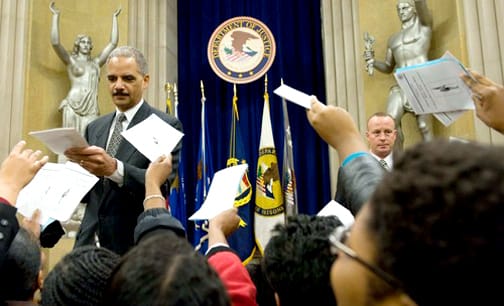
http://www.sfbayview.com/wp-content/uploads/eric-holder-autographs-staffs-black-history-month-programs-021809-by-saul-loeb-afp-getty-images.jpg
Tuesday, November 24, 2009
Citations for Images
This is not an actual post to be counted in the ten required ones. This is just a post for citing any images used in my blog. Thanks!
http://staytondailyphoto.com/photos/stained_glass_church2.jpg
http://farm1.static.flickr.com/247/516707238_e42e894199.jpg
http://farm1.static.flickr.com/19/119526091_054c09d507.jpg
http://persia1.files.wordpress.com/2008/09/isfahan-imam-night.jpg
http://images-3.redbubble.net/img/art/size:large/view:main/2167884-2-explosive-abstract-painting.jpg
http://www.danhagerman.com/images/Bronx%20Ghetto.jpg
http://picayune.uclick.com/comics/crmlu/2008/crmlu081109.gif )
Sunday, November 22, 2009
Image Study
(NOTE: Below are four distint images that I have chosen for significant reasons. Though there are countless simple and broad images seen throughout the novel, such as war, terrorism and the Middle East, I have decided to take my analysis much farther and deeper. I carefully selected these images because they really stand out to me and are very significant to the novel. They did in fact take much longer time to develop a detailed analysis for, but hopefully the quotes and images that I chose can help support them with a much more clearer understanding.)
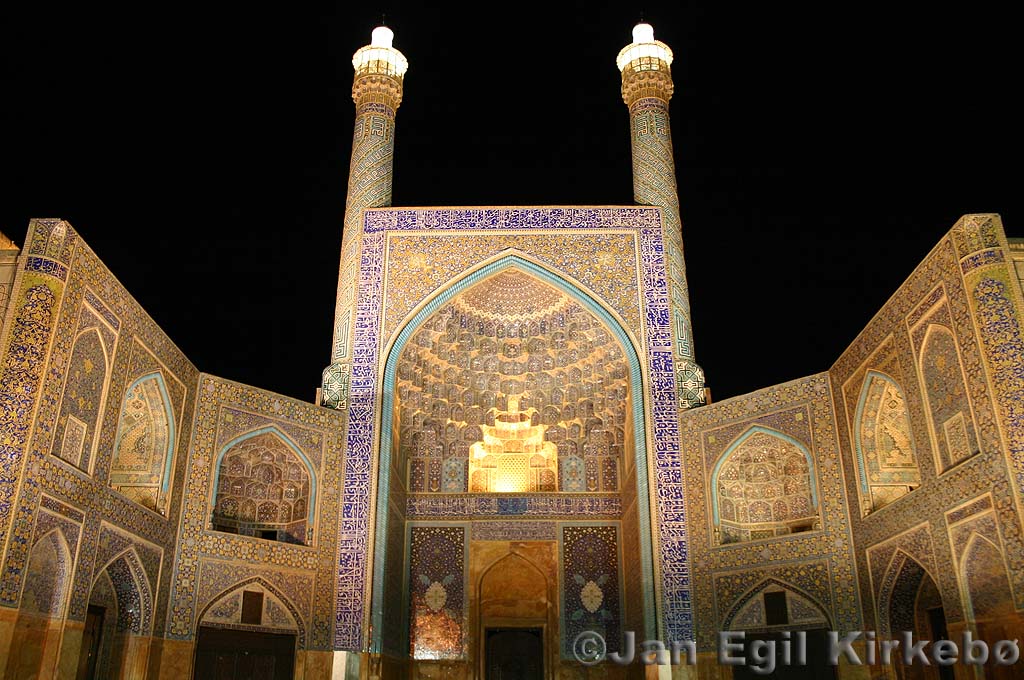
"The windows of this church, blasphemously assigning God a face, and gesturing hands, sandalled feet and tinted robes..."
"The soot-stained ironstone church beside the lake of rubble is filled inside with pastel cotton dresses and sharp-shouldered polyester suits."
"The receding rows of seated and sexually mixed people, and the stagy confused area at the front with its built-in knobbed furniture... all seem to Ahmad more like a movie theatre before the movie started."


"Religion to me is a matter of attitude. It's saying yes to life. You have to trust that there's a purpose, or you'll sink. When I paint, I just have to believe that beauty will emerge. Painting abstract, you don't have a pretty landscape or bowl of oranges to lean on; it has to come purely from you. You have to shut your eyes, so to speak, and take a leap. You have to say yes."

The quote above is my most favorite quote from the entire novel, and it is said by Ahmad's mother, Terry, who is an abstract painter. At this point of the novel, she is speaking to Ahmad's guidance counselor, Dr. Levy, who came to their house to speak to her about her concern for Ahmad and his future. They are discussing religion and he asks how she is okay with his strong devotion to Islam. Her reply is very powerful, beautiful and well-said. She is not concerned with what other people may think about her son's religion choice. Instead, she "encouraged him at it. I'd pick him up at the mosque after school in the winter months. I shook the imam's hand every time I saw him." She compares her thoughts on religion to her reason for painting, and why it is important to trust yourself in order to get an extraordinary outcome. Her theory cannot only be used in painting, but in everyone's life. I learned from past experiences that we all have a tendency to hold ourselves back because of our fear. If we could only completely let go of it, and trust ourselves, that is when we are truly living. The image above is what I pictured in my head while reading this quote and descriptions of her paintings of "the wildest colors blended together." It may take a while to see the beauty and power in it, but as she says, "I just have to believe that beauty will emerge." Take a few minutes to study the striking painting above, and see how long it takes for the beauty to emerge for you.
New Prospect, New Jersey --> A depressed industrial town
 All of the descriptions of the setting and places in the novel are depressing, dark and gloomy. Images of urban decay remains consistent throughout the entire novel. For example, Ahmad's high school is described as “rich in scars and crumbling asbestos...sits on the edge of a wide lake of rubble.” Later when Ahmad is walking his black girl friend Joryleen home, her environment is described as the “neighborhood grows shaggier around them; bushes are untended, houses unpainted, sidewalk squares in places tilted and cracked by tree roots underneath; the little front yards are speckled with litter. The rows of houses lack a few, like teeth knocked out, the gaps fenced in but the thick chain-link fencing cut and twisted....” Updike notes the “asphalt avenue...with its patched and repatched potholes and the tarry swales created by the constant weight of rushing cars and trucks....” The images of decay and depression are extremely significant because in my opinion they tie together with Updike's opinion of America as a nation: that we are a dying nation if we continue to take the path that we are currently taking, economically and politically. Though most descriptions are negative as described above, it is easy to miss his more powerful descriptions such as "...the sky cloudless but for a puffy far scatter over Long Island, the ozone at the zenith so intense it seems a smooth-walled pit of blue fire, the accumulated towers of lower Manhattan a single gleaming mass, speedboats purring and sailboats tilting in the bay, the cries and conversation of the tourist crowd making a dapple of harmless sound around them. 'This beauty,' Ahmad thinks 'must mean something -- a hint from Allah, a foreshadow of Paradise.' " The image above is the picture I see in my head while reading about the setting: a city that is ghetto, lower-class and contains a higher percentage of poverty. But then again, this is the image that Updike wants to evoke. So, well done Updike. Mission accomplished.
America: Not Always a Pretty Picture
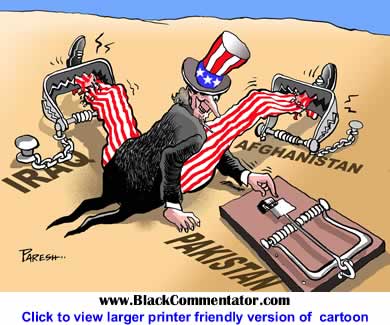
Looking into Terrorist from a much more deeper perspective, it is important to ask: Why did Updike write this novel? What sparked his interest for writing in the position of a very devout Muslim boy? Reading this novel really shines a different light over America, and not the light we are all used to. It makes us stop and think about our nation as a whole, and what we have become and what has changed over the past decade. Many critics have severely criticized him for being anti-American and using Ahmad to voice his opinions and complains of America, but I have to side with Updike on this one and commend him on his goal to make Americans step outside their comfort zone and see how our nation is seen through the eyes of Muslims who are dying everyday in Iraq. We need to question and be more concerned with what our nation is exactly doing in the Middle East and how we are handling the situation over there. As Ahmad says, "[True adherents] believe that a billion followers of Islam need not have their eyes and ears and souls corrupted by the poisonous entertainments of Hollywood and a ruthless economic imperialism whose Christian-Jewish God is a decrepit idol, a mere mask concealing the despair of atheists." Unfortunately, this is an image that many people and countries around the world have of America. Even the school's white American guidance counselor Jack Levy bitterly sees America as a “paved solid with fat and tar, a coast-to-coast tarbaby where we’re all stuck.” This is an interesting perspective that Updike gives us, though it may not be something we are used to thinking about, it is a view that we should at least consider if we hope to come to peaceful terms with the billions of Muslims who are solid citizens of this and the world's other nations and who have no hostile intentions against us. The image above is the type of political cartoon that comes to my mind when thinking about what other countries around the globe think about America and their intentions. Harsh, but then again so is the innocent killings of Iraqi civilians, including innocent infants and mothers.
